How to profit from REALLY poor #service!

Last Friday my wife and I drove 2.5 hours to Charleston, WV, in order to purchase a 5-year pre-check pass from the TSA for $85 each. Most sites have a waiting time of a month for an appointment to buy the pre-check. There are three clear benefits from the pass:

  1. Skip the “TSA Strip Tease.” You know the dance: remove your shoes, jacket, sweater, belt, wallet, phone, change, etc. Hold up your arms and see if your trousers stay in place. (All without accompanying music!)
  2. Leave your computers, electrical gear, and shampoo in your carry-on case.
  3. Clear security faster.

TSA

The TSA collects $17 per year from each participant PLUS costs go down since not everyone goes through the same torture process. A true Win-win for the TSA!

I was wondering if other notorious bad service providers have similar profit opportunities…

How much would you pay annually to:

Continue reading

Posted in Service Design | Tagged , , , , | Leave a comment

Should you involve customers? How radical and hedonic are you trying to be?

When does a firm benefit from customer co-creation?

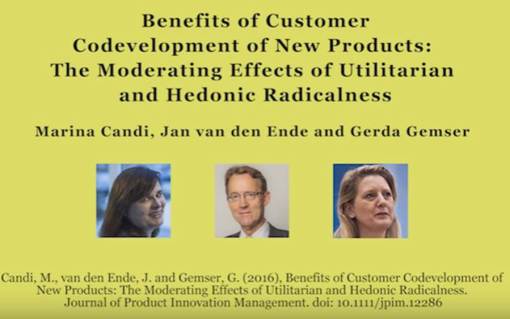
The leading journal of product innovation, JPIM, has a cool YouTube channel to view short summaries of selected articles on innovation. I strongly recommend checking it every couple months for new posted videos. Even if, like me, you read the journal cover-to-cover every issue, it is interesting to see how the authors portray their research via video.

Readers of a blog originally titled “Service Co-creation” will undoubtedly be interested in this video – which asks when does a firm benefit from customer co-creation. The authors found that benefits from customer involvement vary based on whether the innovation is:

  • Incremental or Radical, and
  • Utilitarian or hedonic.

Watch the video to get the insights:

Video LInk


Candi


This full article is featured in the July issue of JPIM.

Again the video link is here.

Posted in Co-creation or User collaboration, communication, Customer Research Methods, NSD Process | Tagged , , , , , , , , | 3 Comments

The Essence of Service – In a Cartoon

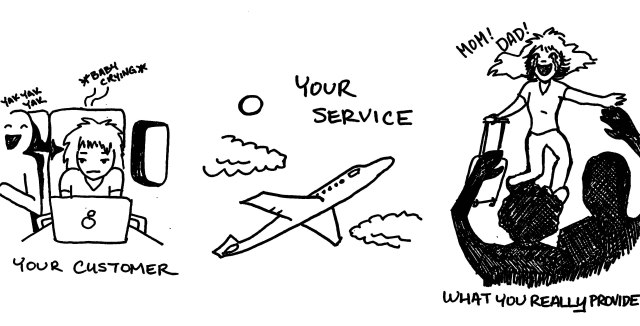
In the middle of final editing for recently published Service Innovation we decided that we needed an illustration in Chapter 1, for our discussion of what service is. I sent a Facebook message to my talented daughter, Kiki Schirr, and asked her if she could send an illustration within 90 minutes. This is what she sent:

Service Innovation 6

The illustration is on page 8 of the book, published last month.

Frame 3 catches the essence of service: the value created with the customer. The young woman, together with the airline were able to create a memorable visit with loved ones.

Frame one adds a more nuanced view. The flight was crowded and noisy, but that was not important to this consumer who was creating a visit at the end. So other customers who might focus more on the experience during the use of the service might not have been as satisfied as the young woman was.

A service provider should understand the value creation process of customers. An effective service innovation process will focus on enhancing both the customer value creation and the service experience.

A single illustration can say a lot!

…………………………


Posted in Co-creation or User collaboration, Customer Research Methods | Tagged , , , , , , | 5 Comments

All Products are #Service – Watch out Small Business?

A central theme in the new book Service Innovation is that “All Products are Service” and that all businesses accordingly should focus on the value-creation and experience of users.

Service InnovationOver 80% of the US economy is service by traditional measures, but increasingly goods are being sold on the basis of ad-on service such Onstar or extended warranties for cars. Servicization actually converts goods into service by providing the benefit of the good not selling the good: airlines pay for hours of thrust for their vehicles instead of buying jet engines; consumers  join monthly mobile phone plans that include keeping phones current. All product ARE service.

A recent post by Elke Stangl, a physicist and small businessperson in Austria, notes the phenomena “Everything as a Service” and argues that servicization bodes ill for small businesspeople.

Certainly when a customer commits to a service for an extended period or entrust another firm to effectively own assets for them, the image of financial stability or size may matter. Even more fundamentally Ms. Stangl raises the issue of the “winner take all” effect popularized by Nassim Taleb in the Black Swan. Due effective communication, globalization, network effects, and scale, services on the Internet seem to quickly have one or a small group of big winners with all other providers instantly marginalized.

Do you agree that “all products are service” or “everything as service” inherently favors large companies? Leads to a small group of winners?

How can small businesses adapt to servicization?


Posted in Service Design, service-dominant logic of marketing | Tagged , , , , , , , , | 8 Comments

Are you a social salesperson? Really?

Are you a social salesperson? All the cool salespeople are! LinkedIn now has a measure to ssi72let you know whether you are: the social selling index (SSI).

The tool must be valid – when I checked it recently I scored 72, which puts me in the top 2% of my industry, according to LinkedIn.

You can check your score – here.

Do I sound cynical about the new index? Well… it was developed by LinkedIn and it measures your content sharing, engagement, profile quality, amount of searches, and communication (including paid inMail): all on LinkedIn. In other words it really measures the extent to which you use their product!

I also believe that influence-measures such as Klout have had a roll in making social media less personal by encouraging everyone to over-post and over-share. The “Hawthorne effect” is powerful in social media – behavior will change when it known to be measured. (For example, I pushed my SSI up from 65 to 72 by posting blog posts twice last week in anticipation of this article.)

Why it may matter

LinkedIn is THE professional network and has been shown to be the the most effective platform for lead generation. The four components of the index are logical for a social seller:

  1. Self-branding,
  2. Search (prospecting?),
  3. Engagement, and
  4. Relationship building.

LinkedIn claims that “Our research shows those with an SSI over 70 see two times the new clients approached, meetings secured, and opportunities gained than those who lag behind.” In a case study of the use of the SSI at Microsoft a sales manager for the software firm claims that for every “ten point increase in SSI, his team sees an average of 4.3 more opportunities.”

It may be self-serving, but the SSI index may signal your effectiveness as a social salesperson.

Again, can check your SSI score – here.

And an article from LinkedIn on how Microsoft uses the SSI index.


Posted in Digital Marketing, Klout, LinkedIn, Selling, social media marketing | Tagged , , , | 2 Comments

Effective Titles: Once more with feeling!

Titles drive the engagement of a blog post. Established bloggers such as Jeff Bullas suggest that you spend just as much time on producing the title as you do writing your post.

In his excellent book on how to deal with content shock, The Content Code, Mark Schaefer reiterates the 50% of time rule and suggests using some of the online title analysis tools to help with title development.

This graph is from aBuffer_headlines_Charts_numbersn interesting article from CoSchedule titled Proof that Emotional Headlines get Shared More on Social Media. Using the emotional index (based on percentage of emotional words in title) titles with an index score of 28 were shared five times as often on average as titles with an emotion in the high teens. Titles in the 38-40 range were shared TEN TIMES as often!


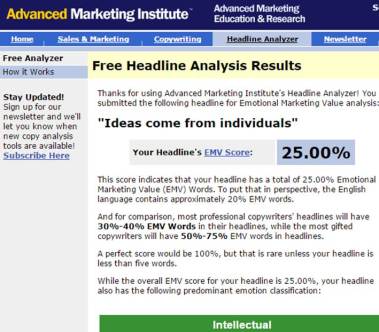
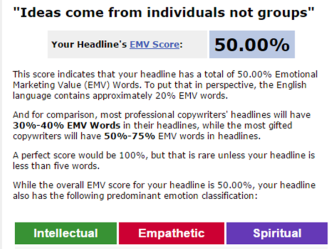
Last week I posted anTitle article on LinkedIn about problems generating ideas using  group brainstorming compared to individuals. I was disappointed with engagement on the first day and decided to take a look at the title. “Ideas come from Individuals” described the article and had a solid emotional index score of 25% as measured by the analyzer on the Advanced Marketing Institute page. The title was classified as “intellectual.”


I then Title2experimented by adding a comma and two words – “, not groups” – to the original title. The emotional index doubled to 50 as shown in the next screen shot, which seems the ideal score. In addition the new title better described the article and showed up as “empathetic” and “spiritual” as well as intellectual!


views

I changed the title the next morning and something unusual happened… the viewership on days 2 and 3 exceeded the views on day one!


Take the time to get the title right!!!


Posted in Blogging, Content, Digital Marketing, social media marketing | Tagged , , , , , , , , , | 2 Comments

Ideation is for INDIVIDUALS, not groups!

Group brainstorming is not a good way to generate innovation ideas.

In the Preface to Sprint, a book my entrepreneur daughter insisted I read, the author discusses his missteps using group brainstorming at Google.

He notes the group brainstorming sessions were “a lot of fun,” participants enjoyed the process, but… they did not generate successful ideas. The best ideas were generated by individuals “sitting at their desks, or waiting at a coffee shop, or taking a shower.”brainstorming3

Jake Knapp’s Preface is a good summary of what I found in a study of 50 years of research on group brainstorming.

Flawed Tools: The Efficacy of Group Research Methods to Generate Customer Ideas” which appeared in the Journal of Product Innovation Management reviewed five decades of experience and research on group brainstorming and some recent data. The study showed that compared to ideas generated by individuals, group methods produced:

  1. Fewer ideas,
  2. Fewer good ideas, and
  3. Fewer really creative ideas.

But… participants did enjoy the process and felt productive….

[Which raises an issue of whether groups might have a role to encourage organizational buy-in for innovation…]

But once again:

GROUP BRAINSTORMING IS NOT A GOOD WAY TO GENERATE INNOVATION IDEAS.

If you want to review the evidence check out the JPIM article here.

Posted in Customer Research Methods, Ideation, NSD Process, Service Design | Tagged , , , , , , , , , | 2 Comments

How to Rant on Twitter!

These Tweets, directed to NFL commissioner Roger Goodell, are from Malcolm @Gladwell – who has previously described the NFL as an “abomination,” due to CTE and physical maiming of its players…

I first saw these collected Tweets in a USA Today report

They were Tweetted about a minute apart… (Pictures and minor commentary mine…)

Oh sarcasm… I think I see where this is going!

RIP Ken Stabler, Earl Morrell, Dave Duerson, Frank Gifford, John Mackay, and so many more

Nick

So nice of the Foundation to pay off the mortgage – hard to live in Tuscaloosa on $7 million a year…


DavisBuild us a new stadium and guarantee revenues or we will move to LA… or San Diego… or Oakland… or London … Shanghai? (Al’s spirit lives on..)


Frog

Posted in Social Media, social media marketing, twitter | Tagged , , , , , , | Leave a comment

Content Shock Illustrated

Mark Schaefer wrote an insightful post about Content Shock two years ago, explaining that a glut of content from hundreds of millions of blogs and websites was testing everyone’s capacity for attention. Therefore content marketing might be an unsustainable strategy for individuals and organizations without the capacity to buy attention.

About that same time LinkedIn began slowly rolling out its new post feature that encouraged people to blog with LinkedIn. I had qualms about using the new platform because of fear of “digital sharecropping” – once again slaving away to create content in order to make a couple nerdy guys in California rich.

I experimented with the new platform and posted 11 articles between June and October 2014. I was delighted with the engagement – averaging over 2,000 views and 25 likes. Even after taking out the highest and lowest viewed posts, each article averaged over 1600 views and 10 likes.

For personal reasons I stopped posting on LinkedIn for 10 months. I have posted 4 posts between August 2015 and today. The drop-off in views, likes and comments has been significant!

Time Period Avg Views Avg Likes Avg Com #Posts
6/14-10/14

2118

26 6.5 11
6-10/14 w/o extremes

1614

12 4

9

8/15 – 1/16

124 9 2

4

I expected a decline, as I had noticed a steady rise in the number of posts every day by the people I follow and and linked to. But the fall really is dramatic. From an average of 1600+ views per article to less than 125 and from 12 likes per article to 9.

By creating a new platform for blogging LinkedIn afforded me a personal accelerated view of Content shock. It looks like this:

Content Shock2

Small sample size, my own experience: this is anecdotal evidence and I would like to hear from others who have been posted on LinkedIn from early 2014 so there would be more evidence. I did anticipate a drop-off in interaction in advance of resuming, though, because of all the content currently being shared – content shock.

How are you dealing with the glut of content???


Posted in Blogging, Content, Digital Marketing, Facebook, LinkedIn, Social Media, social media marketing | 7 Comments

#Cluetrain Derailed!

The Cluetrain is derailed.

Last Spring Adage pronounced that “There is no more social media marketing: just advertising.” The article announced a new era of #NotReallySocialMediaMarketing and went on to proclaim:

“The idealistic end to business as usual, as “The Cluetrain Manifesto” envisioned, never happened. We didn’t reach the finish line. We didn’t even come close. After a promising start — a glimmer of hope — we’re back to business as usual.”

I love Big Brother

My first social media marketing class was Spring 2012. It was a brand new class – there were no syllabi online to crib, so I built the course fresh with the help of my Twitter friends. I proclaimed that “marketers must drop the megaphone – broadcasting or shouting at customers and prospects is dead! We must engage and have a CONVERSATION.” Our group projects were to work with organizations to show them how to have that conversation….

Tomorrow I will face two new sections of my SMM class. I will talk to them about the ominous and omnipotent Facebook algorithm, social media advertising, and sponsored posts. I require them to be Google AdWord certified. For our group projects we will participate in the Google Marketing Challenge and use AdWords to help organizations with their marketing efforts.

Using AdWords is a valuable skill. Translating that skill to the evolving world of paid posts and social media advertising is challenging and interesting. My social media marketing class will continue to be a vital part of digital marketing and the marketing curriculum.

But I really love Cluetrain

I love the original manifesto! I want to believe in “the conversation” and “content marketing.” We should return to the craft model of having a genuine relationship with our customers. We absolutely should stop shouting and drop the megaphone.

“Organic” communication is so much kinder than paid ads. The idea of a “Like Economy” was really cool.

Just two years ago I warned that Zuckerberg was using the algorithm-formerly-known-as-EdgeRank to kill the Like Economy. At the same time Mark Schaefer noted that even without malignant forces such as Zuck and Facebook, content shock would wreck havoc on organic marketing strategies as audiences were buried in a deluge of information.

Organizations: learn the ins and outs of online and social advertising. A conversation sounds civilized, but you have to reach your audience.

Wishing doesn’t make it so…  The Cluetrain is off the tracks!


Posted in Content, Digital Marketing, Social Media, social media marketing, Teaching SMM | Tagged , , , , , , , , , | 4 Comments