Pioneers get arrows in their backs…

Apple’s great timing

Two recent articles have heralded Steven Jobs’ excellent timing of innovation:

  • David Aaker’s article on his blog asked “Why wasn’t the iPod a Sony brand?”: As David relates, Sony had launched two digit players two years earlier, but the technology was not yet right. Apple waited then launched when affordable flash memory was available. Article: WhyNotSony
  • “How Apple Foot-Dragged to Victory” by HOLMAN W. JENKINS, JR. (WSJ), notes that: “Mr. Jobs’s slowness is the key to Apple’s success. His focus on the device, his emphasis on perfecting the user experience, meant holding back, not overreaching. The iPod would only be a music player. The iPhone and iPad would be Web-browsing devices that wouldn’t play most of the video on the Web… And notice that each of these device categories had been around for five or 10 years by the time Apple entered (clobbered) them.”

First mover advantage?

Is Steven Jobs the exception to the well-known “first mover advantage?” We all know how pioneers such as Apple Computer (in PCs), Gillette (in safety razors), Hewlett-Packard (laser printers), and Microsoft (PC operating systems) commanded long term market dominance by being first…

However in reality none of those firms in the previous list was first…or second…or third to market! Most entered the market 3-5 years or more after the first entrants. Bill Gates bought DOS on the cheap after he sold IBM on the product! As Tellis and Golder point out in their book Will and Vision, most of the companies we assume were first to market have simply benefitted from “survival bias” or “the-winners-write-history” syndrome.

If it weren’t for the movie The Social Network within a decade or so we would all probably have come to believe that at least some key attribute of Facebook was introduced by Zuckerberg; and would have forgotten Geocities, Friendster, MySpace, and ConnectU (Winklevoss twins). [And of course even the W twins weren’t the first to think of marrying MySpace features to elite college .edu addresses…]

Will and Vision

It turns out that Pioneers often do end up with arrows in their backs and latecomers win the categories. What factors decide winners? Tellis and Golder explore key factors. Two of the biggest are persistence and continual innovation in response to market feedback. Tellis and Golder provide further support of principles underlying:

  • Probe-and-learn
  • Experimentation or rapid prototyping
  • Lean Startups
  • Effectuation
  • Agile development

Strongly recommended:

Book by Tellis and Golder: Will & Vision: How Latecomers Grow to Dominate Markets

Posted in effectuation, entrepreneurship, experiential innovation, Experiment, Ideation, Slow Burn Entrepreneurship | Tagged , , , , , , , , | Leave a comment

Reflections on two years of tweeting

Actually it was two years in March, but I sometimes procrastinate a bit…

I had two purposes when I signed up for twitter: (1) to promote my year-old blog and (2) to try to understand the twitter phenomenon. My first tweets were classic newbie tweets – “trying to figure out what this is all about” and “read my blog at www.servicecocreation.com “. I was slow to figure out what it was about, but benefitted from early connections to people like @waynemarr, @kenthuffman, and @markwschaefer who tried to explain it to me.

I connected to marketing professors and consultants. Kent’s list of “top marketing professors” inspired me to continue to connect with people so I could make his list which had a cutoff of 500 followers. The habit of seeking out interesting tweeters and then looking at who they followed and who twitter said was like them, caused my numbers to grow.

From Broadcasting to Social Engagement

But the most important discovery was from @markwschaefer and a new tweeter who I originally helped a bit, @ckburgess, who showed this “broadcaster” that twitter was actually a social media. Why not converse on twitter? Virtual friends can become real friends… I have made friends and linked to really interesting people as I began to interact not just broadcast.

My initial objectives were met: blog viewings went from 10/day to 50 or more with over 100 subscribers and many more comments and tweets from the site. One article was recently viewed by over 1000 persons in 3 days and tweeting almost 200 times. I think I now also have some idea of twitter’s potential.

Virtual world spills into the real world!

The coolest discoveries were benefits to my real world life: when I decided to enter a last minute grant proposal for a social media marketing course a couple tweets and a blog posting resulted in a lead user community to co-create the proposal.

Just a few weeks later I needed a proposal for a conference presentation and in 48 hours combined a couple blog articles into a conference paper!

My online efforts are now spilling over into my daily life! For a more thorough review of twitter see my earlier post on Mark’s excellent book, The Tao of Twitter.

Posted in Social Media Marketing | Tagged , , , , , | 3 Comments

Computers in the classroom: no surfin’

On the first day of class I announce that there are to be no computers open during class discussion or lectures. (Of course they are permitted or encouraged during group work or for some online exercises, but that is an entirely different issue.) My pronouncement generally elicits horrified looks from 20-25% of the class and a student or two may choose to drop my course at that point.

Some of the strongest reaction has come from colleagues or profs from other schools. “If I didn’t think I could compete with the internet, I would give up teaching” is a common refrain, often uttered by someone who has trouble communicating one-on-one. As if his fascinating talk on advanced auditing was more interesting than the beer pong pics just posted on FB! Never mind that current research on learning indicates that attention is the most important factor in learning and multitasking of any sort kills attention and learning. Multitasking

In the book, The Shallows, studies are cited showing that  hyperlinks to citations in the text of a paper impair learning: imagine having Facebook and YouTube in your control bar while you are trying to take lecture notes! As Aaron Herrington, founder of Modea, said in a recent lecture: “online you are always 1-click or 3 seconds away from cute kittens or porn.”

Even after a keynote speech on Brain research and learning that focused on attention and the risks of multitasking at a recent conference on pedagogy, I get the standard pushback from other faculty when I said that I banned open devices. “If I didn’t think…”

However two young women who had recently graduated from the well-known research university across the river from my school were there. They both said that they wished their professors had banned computers from their large lecture classes because of the third-party effects: even though they kept their own computers shut the noise from the student next to them playing WOW and the embarrassment at the guys in front of them viewing porn affected their concentration.

So profs be honest. Open computers, students communicating on FB and viewing YouTube movies and free porn, may help keep your class happier and more docile – especially in large lecture classes, but it does not aid learning by them or their neighbors!

Posted in Uncategorized | Tagged , , , , | 7 Comments

Is “Lean Startups” a misnomer?

In an article last week, I showed that the careful-experiment, iterative, innovation process called “Build-Measure-Learn” by Eric Ries had earlier emerged in a dissertation research by Gary Lynn as “Probe-(study)-Learn” twenty years earlier. Dr. Lynn studied goods-producing firms. There are good reasons to be aware of the earlier studies

  1. Thought pioneers should receive proper credit. But more importantly…
  2. The experimental iterative has been known in the product development literature for over 20 years, so it should be a robust theory.
  3. The process originally emerged in studies of discontinuous hardware, so the principles should apply universally, not just to web-based businesses or software.

Lean or Not?

One interesting contrast between the “Probe and Learn” article and the writing of Eric Ries on Lean Startups is that the former actually go to great lengths to contrast their procedure to the Lean Process. Lynn et al. cite The Machine that Changed the World several times and note that their Probe and Learn procedure is for discontinuous innovation not for the mundane innovation described in that book (which is one of the original works on Lean). Ries also stresses that Lean Startups are doing discontinuous innovation…

Interesting issue! The authors of “Probe and Learn” viewed it partially as an antidote to Lean Thinking while a promoter of the process for startups views it as a Lean process…

I have thought about it and conversed with a friend at the Lean Institute and I think Lean Startups is OK and that “Probe and Learn” could have been called lean innovation: What do you think???

For more information I recommend:

Posted in Co-creation or User collaboration, Customer Research Methods, effectuation, entrepreneurship, experiential innovation, Experiment, Slow Burn Entrepreneurship | Tagged , , | Leave a comment

Crush It! A Review

My review of Crush It! by Gary Vaynerchuk:

http://www.youtube.com/watch?v=Jl8WazUWlks

YouTube link: http://www.youtube.com/watch?v=Jl8WazUWlks

Amazon link: Crush It!: Why NOW Is the Time to Cash In on Your Passion

Feel free to buy, borrow or steal the book anywhere! Using the Amazon link above merely abets my Amazon addiction…

Posted in Social Media Marketing | Leave a comment

Before “Lean Startups” there was “Probe and Learn”

I have written about Lean Startups, both the phenomena and the writings of Eric Ries and Steven G. Blank in a recent article and will continue to do so. I would suggest that anyone interested in innovation and entrepreneurship read Ries’s blog and consider his upcoming book (links to both are at the end of this article.)

In his articles Eric Ries describes how web entrepreneurs launch “Lean Startups.” He focuses on the need for a new style of management and metrics to conduct careful experiments on “minimum viable products.” Bringing radical or discontinuous innovations to market can be described as:

  • Build a “minimum viable product” to take to market as a controlled experiment
  • Measure results
  • Learn
  • Iterate with followup experiments

This experimental, iterative process is ideal to bring discontinuous products to the market. Most examples Ries cites are web-based services or software but he asserts in several articles that the process can be applied elsewhere.

TWENTY years ago…

Gary Lynn published his dissertation in 1993. He had collected data from manufacturers of high-tech business and medical devices that had or were bringing a discontinuous new product to market. He found that the process was vastly different from incremental product innovations that depended on traditional marketing research. He and his co-authors found a process they called Probe and Learn defined as:

  • Probe – bring an “immature” product to market as a controlled experiment
  • [carefully study the market results]
  • Learn
  • Iterate with new experiments 

Do you feel you have seen the “probe and learn” process before? I certainly do!! (Of course both also strongly resemble Lean improvement, E.W. Deming’s change model, and the scientific method…)

It seems fair that Gary Lynn and his co-authors get credit for the process that they discovered, but even more importantly for our purposes it is useful to note that he found the process by studying goods-producers. Therefore iterative “Build-Measure-Learn” using “minimum viable products”, or iterative “Probe and Learn” using “immature products” are indeed generalizable far beyond the world of internet services and software.

In a future article I will look at the subtle differences between Probe and Learn and methods of Lean Startups and the contribution that Ries and Blank are making beyond the Probe and Learn model.

For more information I recommend:

Posted in Co-creation or User collaboration, Customer Research Methods, effectuation, entrepreneurship, experiential innovation, Experiment, Slow Burn Entrepreneurship, Uncategorized | Tagged , , , , , , , , | 2 Comments

Social Media Strategies for Professionals

My review of Social Media Strategies for Professionals and their Firms by Michelle Golden:

YouTube link: http://www.youtube.com/watch?v=KV7b-hLfR14

Amazon: Social Media Strategies for Professionals and Their Firms: The Guide to Establishing Credibility and Accelerating Relationships (Wiley Professional Advisory)

Feel free to buy, borrow or steal the book anywhere! Using the Amazon link above merely abets my Amazon addiction…

Posted in Social Media Marketing | Leave a comment

Book Review: The Tao of Twitter

My review of The Tao of Twitter by Mark W Schaefer:

YouTube link: http://www.youtube.com/watch?v=FaOFmA4XA68

To order from Amazon:

The Tao of Twitter: Changing your life and business 140 characters at a time

Feel free to buy, borrow or steal the book anywhere! Using the Amazon link above merely abets my Amazon addiction…

(Thanks to my twitter and other SM “friends” who gently pointed out to me that 5 minutes is too #$@% long for a video review!)

Posted in Social Media Marketing | Tagged , , , | 4 Comments

Social Media and User Research Methods

Social media and online communities of users are increasing and changing user input into new product and service development. We are all familiar with crowdsourcing and monitoring of user input online.

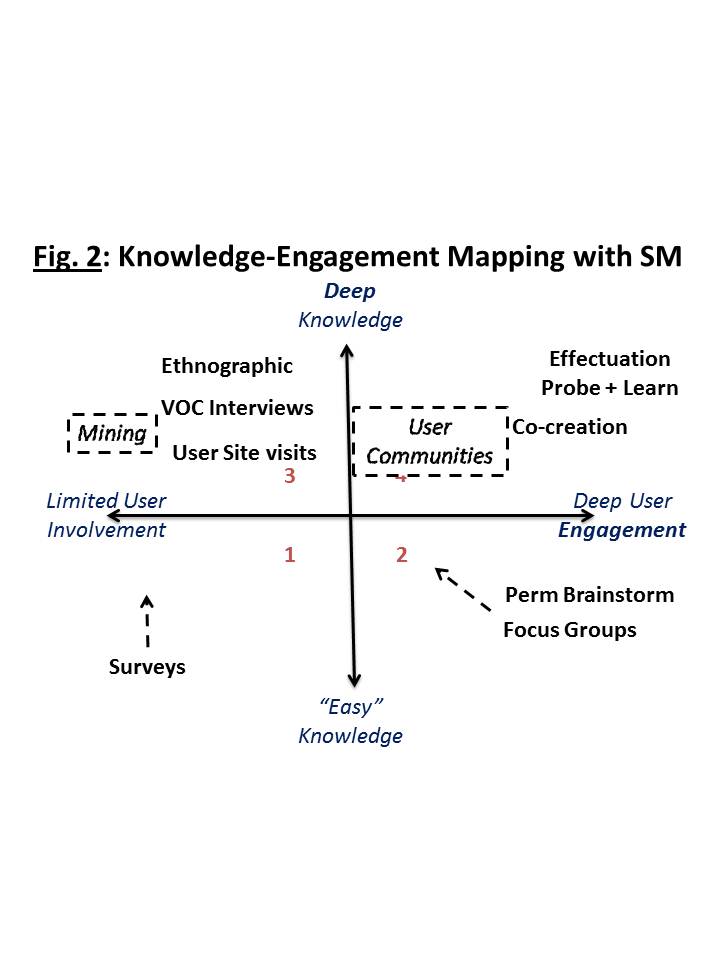
If you haven’t already, consider reading my feature article in the current issue of Social Media Marketing Magazine: http://dld.bz/SUdJ In that article I used a deep knowledge / engagement framework to categorize user research methods.

Getting at deep (or “sticky” or “contextual”) user information is the motivation of such research methods as ethnography and voice-of-the-customer.

Engagement is another dimension that draws users to tap their own creativity to improve the product or service. Examples of methods that both access deep knowledge and engage the users would be crowsourcing, open-source software development and the lead user method of Eric Von Hippel. The following diagram shows is my effort to map user research methods by deep knowledge / engagement AND show how social media is already having an impact.

Continue reading

Posted in Co-creation or User collaboration, Customer Research Methods, experiential innovation, Ideation, Social Media Marketing | 3 Comments

Lean Start-ups or Slow-burn entrepreneurship

In addition to the mountains and the mild 4-season climate,  a great benefit of living in the New River Valley of Virginia is the NCTC – the technology council of the NRV and Roanoke. Due in part to Virginia Tech, Radford U., and the Carilion Clinic, the area has vibrant technology and startup communities. Last week Doug Juanarena of Rackspace and David Catalano of Modea , both mentors at DayOne Ventures, a local venture seed group,  led a discussion of “Lean Start-ups.”

Lean Start-ups

Due to cloud computing and services available from online vendors it is possible for online and web-based firms to keep costs low in their early stages. DayOne will seed a new venture with $16,ooo and help them find cheap space. Ideally the next stage of financing can also be moderate and be done by a seed or angel firm, perhaps using convertible notes. There are two major benefits of avoiding venture capital funding in their early development:

  1. The founders retain control and avoid dilution of ownership, and
  2. The firm retains the ability to be flexible and change business model in reaction to market experience.

Not surprisingly both start-up speakers at the event, David Poteet of  Nomad Mobile Guides and Frederick Cook of Heyo, described an effectuation process: a small initial investment, rushing a “just good enough” early product to market, and changing the product and business model in response to market lessons. (Both firms seem to be making great strides – check out their links at the end of this article).

Continue reading

Posted in Co-creation or User collaboration, experiential innovation, Experiment | Tagged , , , , , , , , , , , , , , , , , , , , | 2 Comments